2026.01.19
Why the Nose? – Thinking in Terms of Intranasal Delivery as a Brain-Focused Approach to NMN –
This column is the first installment of a four-part series focusing on intranasal NMN.
Rather than discussing NMN solely as a compound, the series examines it from four perspectives: the brain, energy, administration routes, and criteria for selection.
In this first article, we begin by outlining the fundamental question: why intranasal administration?

Are these changes something that can simply be attributed to aging?
- Difficulty maintaining concentration for long periods
- Taking longer to organize thoughts
- Names or words momentarily failing to come to mind
When experiencing such changes, many people attribute them to aging, busyness, or fatigue, and move on without giving them much thought.
Those in positions that require constant judgment and decision-making are particularly prone to telling themselves, “There’s no real problem yet,” or “Work is still getting done.”
At the same time, many may sense, somewhere beneath the surface, that
The brain does not simply “decline” — its conditions change
Recent research increasingly suggests that
In other words, this perspective goes beyond:
- Issues of willpower or focus alone
- Simple declines in information-processing capacity
- And instead considers whether the “conditions” required for optimal brain function have shifted
From this standpoint, what becomes important is not only what is supplied to the brain, but also how it is delivered.
Why NMN is now discussed in the context of the brain
NMN has traditionally been discussed in relation to whole-body energy and aging.
More recently, however, attention has also turned toward its relationship with brain function.
One reason for this shift is the well-established fact that the brain is one of the most energy-demanding organs in the body.
Continuous decision-making and complex information processing require a consistently high energy state.
However, the brain is protected by a significant barrier
There is an often-overlooked reality here.
The brain is an organ with particularly robust protective mechanisms.
As a result, even substances taken orally or administered intravenously cannot be assumed to meaningfully reach or influence the brain.
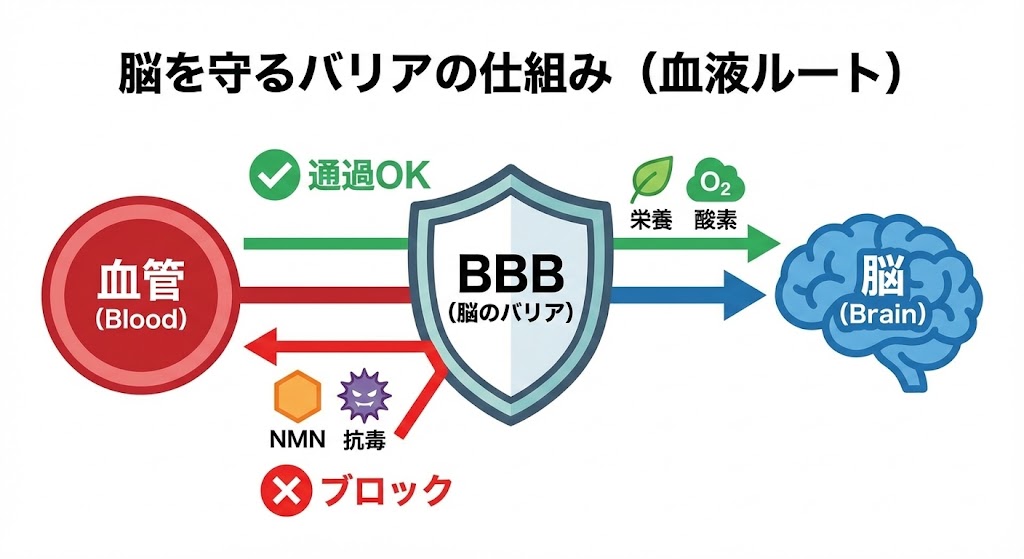
That said, the blood–brain barrier is not an absolute wall.
For this reason, research has increasingly focused not only on the substance itself, but also on the method of administration.
Why delivery methods have become part of the discussion
Against this backdrop,
Because the nasal cavity is anatomically close to the brain, discussions have focused on factors such as:
- A route that bypasses the digestive tract
- Prior investigation of nasal pathways for certain substances
It is important to note that intranasal administration is not an established method for directly acting on the brain.
At present, it is more accurately described as a route of administration that has attracted research interest in relation to the brain.
What distinguishes oral, intravenous, and intranasal administration?
NMN intake is generally considered in three main forms.
Crucially, these methods should not be compared in terms of superiority or inferiority.
-

Oral (supplements)
Absorbed through the digestive system and processed by the liver before entering systemic circulation. Suitable for daily use.
-
Intravenous (IV infusion)
Designed to increase blood concentrations, with a primary focus on systemic effects.
-
Intranasal
Administration through the nasal mucosa. This route has been studied in relation to the brain.
Even with the same compound, NMN, the significance of each method depends on the primary objective.
These differences represent
Key points from this article
- Routes of NMN administration can be understood in terms of differing roles, not superiority
- Intranasal administration is often discussed in relation to the brain, but should be viewed in context rather than as a special case
- How a substance is delivered is becoming an increasingly important consideration, alongside the substance itself
In summary
When noticing changes such as forgetfulness or reduced concentration, it may be worth considering not only age-related explanations, but also how the brain’s operating conditions may have shifted, and whether delivery methods matter.
Intranasal NMN is one approach discussed within this broader framework of “proximity to the brain.”
In this series, Part 2 will explore brain energy, Part 3 will address how different methods are used, and Part 4 will outline criteria for decision-making.
We encourage readers to review the full series before determining which approach may be most appropriate.
Learn more about our NMN treatments
Coming up next
The next article will focus on why the brain requires such a large amount of energy.
We will explain the relationship between brain energy, NAD+, and mitochondria in an accessible manner.
By understanding where the brain may experience an “energy shortfall,” the rationale behind interest in intranasal NMN should become clearer.
This article is intended to introduce research background and perspectives only and does not indicate any specific effects or efficacy.
Please consult a physician before considering any treatment or use.