2026.03.02
What Is Supplement Absorption? How to Improve Cellular Utilization

In the previous article, we discussed how genetic and metabolic capacities differ among individuals.
This time, we will look more closely at how these individual differences may influence treatment outcomes from a perspective closer to clinical practice.
If you have been following our column, you may already be familiar with differences in “administration routes (DDS)” for delivering substances into the body.
Oral supplements, intravenous infusions, and nasal administration each have their advantages, and selecting the appropriate method according to the purpose is important.
However, there is one important medical reality that must be acknowledged.
Even if a substance is delivered through an optimal route, it does not necessarily mean that cells are effectively utilizing it.
In this article, we explain the often-overlooked distinction between “Delivery” and “Utilization.”
Are the “packages” piling up at the doorstep?
Let us compare nutrient delivery to parcel shipping.
Oral intake is like transporting goods by truck via general roads. It may be delayed by “traffic congestion” (hepatic metabolism).
Intravenous infusion or nasal administration can be compared to express highways or drones that deliver directly to the destination (bloodstream or brain).
While these routes may allow components such as NMN to reach “the front of the house (near the cells)” more efficiently, what truly matters in biohacking is whether the package enters “the house (inside the cell)” and is “opened and used (converted into NAD+).”
Even if a large quantity is delivered, if the recipient (cell membrane transporters or enzymes) is unavailable or the “door” (receptors) does not open, the package may remain outside and eventually be degraded or excreted.
High blood concentration does not automatically mean effective utilization
Medical institutions often measure blood concentration.
While this is an important indicator, it only shows how many “trucks” are traveling on the “road” (bloodstream).
What truly matters is tissue concentration (whether it entered the cell) and metabolic activity (whether it was converted into energy).
For example, intravenous infusion may rapidly increase blood concentration.
Cells in individuals with higher metabolic activity may absorb and convert it more efficiently.
Conversely, when metabolic pathways are not functioning optimally, research suggests that nutrients may be less effectively utilized within cells.
This may partly explain why some individuals perceive limited effects despite receiving advanced treatment.
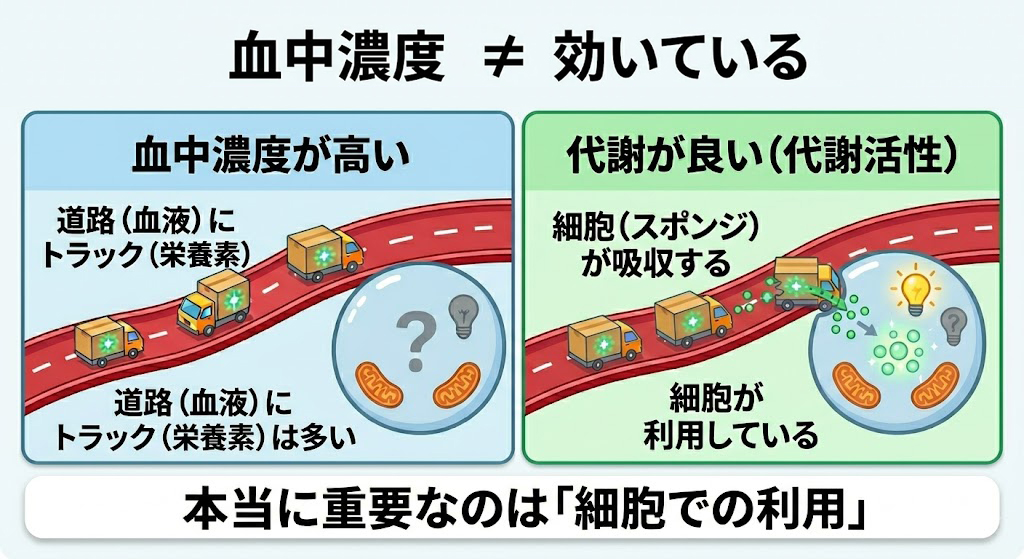
Tracking what happens after delivery
True biohacking requires looking beyond assumptions such as “nasal administration is sufficient” or “IV is the strongest.”
- Are cells actually receiving the substance?
- After receiving it, can it be properly converted into energy (NAD+)?
- Or is it accumulating without proper conversion?
Previously, these intracellular processes were largely a black box.
However, recent advances in science aim to quantify even these internal processes.
Key points summarized
- Selecting the optimal administration route is important, but it is only the starting point.
- “Delivery” and “Utilization” are fundamentally different concepts.
- High blood concentration alone may be insufficient; effective intracellular metabolism plays a crucial role in perceived outcomes.
Recap
This article explained the barrier of intracellular utilization that exists beyond DDS (delivery systems).
If you feel “I am using good substances, yet something seems lacking,” the issue may lie not in the delivery route but in the metabolic system of the recipient side.
In discussing metabolism, it is also essential to address the handling of by-products generated during energy production.
Next time, we will explain the internal system known as “Methylation”, which must be carefully managed when increasing metabolic activity.
This article is intended to introduce research background and perspectives only and does not indicate any specific effects or efficacy.
Please consult a physician before considering any treatment or use.