2026.03.16
What Is Metabolomics? Understanding Your Body’s Metabolic State Through Metabolite Analysis
- Episode 1: What is Biohacking? A Scientific Approach to Managing Health with Data
- Episode 2: Why Supplements Don’t Work | Explaining Individual Differences in Genetics and Metabolism
- Episode 3: What Is Supplement Absorption Rate? How to Improve Cellular Utilization
- Episode 4: Important Considerations for NAD+ Supplements | The Relationship Between NAM and Methyl Groups
In the previous article, we discussed how consuming compounds such as NMN to produce energy (NAD+) simultaneously generates “metabolites (NAM)” and requires attention to the “balance of methyl groups.” The theoretical framework should now be clear.
However, at this point many readers may be wondering something very practical.
“The theory makes sense. But
That is a valid question.
Until recently, visualizing the body’s microscopic metabolic cycles was extremely difficult even in clinical medicine. However, advances in scientific technology are making it increasingly possible to visualize metabolic processes that were previously invisible.
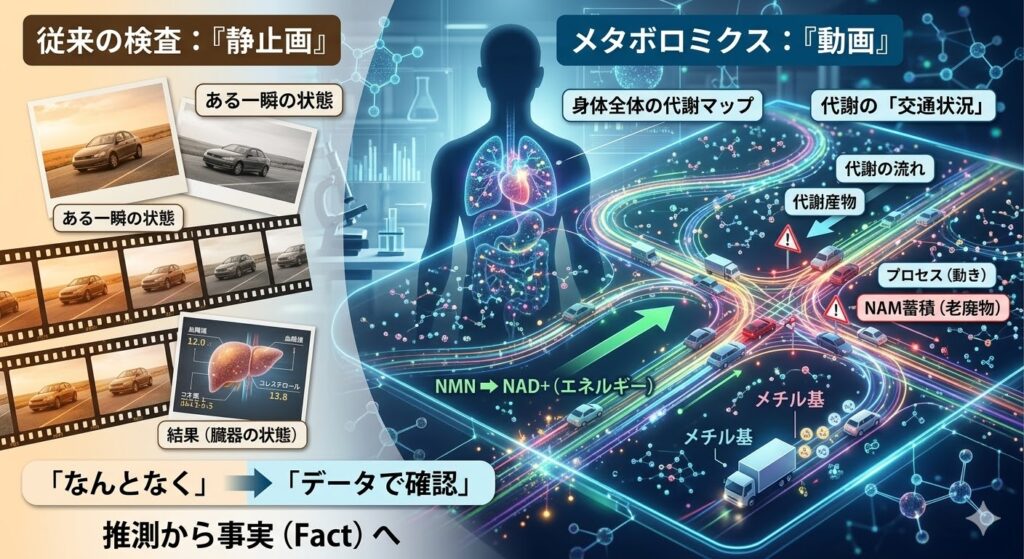
Metabolomics, by contrast, is more like a “movie.” By comprehensively analyzing hundreds or even thousands of “metabolites” present in the blood, it becomes possible to capture the dynamic process of chemical reactions occurring inside the body.
In other words, rather than simply confirming that “a car is present” (a compound exists), this technology allows us to observe “which direction the car is moving” and “where traffic congestion occurs.”
Obtaining a Map of Your Internal System
Let us apply this technology to the previous discussion about NMN and energy metabolism.
Traditional tests could only determine something like “whether NMN is present in the bloodstream.”
However, metabolomics analysis can create a far more detailed “metabolic map,” such as:
- Conversion Efficiency
Has the NMN you consumed actually been converted into NAD+ (energy), or has it stopped somewhere earlier in the pathway? - Waste Accumulation
Is used NAM (nicotinamide) accumulating excessively and acting as a metabolic brake? - Methylation Status
Are there enough methyl groups available to process and eliminate NAM, or are they becoming depleted?
It is becoming increasingly possible to measure these parameters quantitatively.
This represents a shift from a world of vague assumptions to one where conditions can be verified through data—a significant change in the approach to health management.
*However, metabolomics analysis is still considered a research-stage technology, and further validation is required for clinical applications.
From “Assumptions” to “Facts”
Until now, nutritional therapies and supplement use have largely been based on educated assumptions.
For example: “Since this generally works, it should work for you as well.”
However, with the advent of metabolomics, it may become possible to manage the body based on measurable facts.
In the future, approaches could include reviewing intake strategies by examining data such as NAD+-related metabolites or the degree of NAM accumulation.
*At present, these personalized approaches remain in the research stage and have not yet been fully established.
This is the essence of what is known as Precision Medicine.
Key Points from This Article
- Traditional blood tests are like “photographs,” showing results (organ conditions), while metabolomics functions more like a “video,” capturing metabolic processes.
- Using this technology, it becomes possible to visualize whether NMN is converted into energy or remains accumulated as metabolic byproducts.
- Instead of relying on assumptions, supplement strategies may eventually be adjusted based on factual data.
Summary
This article introduced the technology of “metabolomics,” which aims to visualize otherwise invisible metabolic processes.
If we can observe the “metabolic map” within our bodies, there will be less need to navigate health management through trial and error in the dark.
Understanding individual differences, selecting appropriate administration methods, considering metabolic balance, and supporting this with measurement technologies may become one comprehensive approach to long-term health management.
The next article will be the final installment.
We will introduce a new service utilizing metabolomics technology that our clinic is preparing to launch, and explain how it may influence future lifestyle management.
This article is intended to introduce research background and perspectives only and does not indicate any specific effects or efficacy.
Please consult a physician before considering any treatment or use.