2026.02.16
What is Biohacking? A Scientific Approach to Managing Health with Data

Originating in Silicon Valley, the term “Biohakkinngu” is becoming established among executives and top athletes worldwide.
Hearing this word might make some imagine body modifications like in Sci-Fi movies or suspicious gadgets. However, true biohakkinngu in modern medicine is not such an eccentric thing.
It is an extremely logical and intelligent health management method involving
Biohakkinngu considered by Tokyo Ginza Wellness & Aging Clinic.
It lies in breaking away from the vague sense of “feeling somewhat good” and controlling life performance based on medical values.
As the first installment of this series, we would like to organize the concept of “Medical Biohakkinngu” that we advocate.
“Not being sick” is not the goal
Traditional Japanese medicine has long focused on “returning minus to zero (treatment).” The approach is to take medicine if you catch a cold, or lower values if they worsen.
In this standard, “health” generally referred to a “state of not being sick.”
However, is the passive state of “just not being sick” what everyone fighting on the front lines of business is seeking?
Probably not.
What you are seeking is likely a
Aiming for this “Optimization” is the mindset of biohakkinngu.
And the most necessary thing for that is not rules of thumb or intuition, but objective “data.”
Would you drive a Ferrari without looking at the gauges?
The human body can be said to be the world’s most exquisite machine, composed of tens of thousands of parts and complex circuits. To use an analogy, it is like an F1 machine or a high-end sports car.
If you were a Ferrari owner, would you try to drive on a highway with the speedometer, tachometer, fuel gauge, and oil temperature gauge all hidden?
You would probably be too scared to step on the gas.
Even if you think “the engine sound is fine (feeling) somewhat,” the oil might be deteriorating inside, or fuel might be running low. If you continue driving at the limit in that state, the engine will eventually seize up and surface as a sudden breakdown (= disease).
However, many people are doing this exact thing to their own bodies.
Is it not the current situation that you continue running on the highway called hard work based only on “Feeling” such as “because I am still young” or “because I slept well yesterday”?
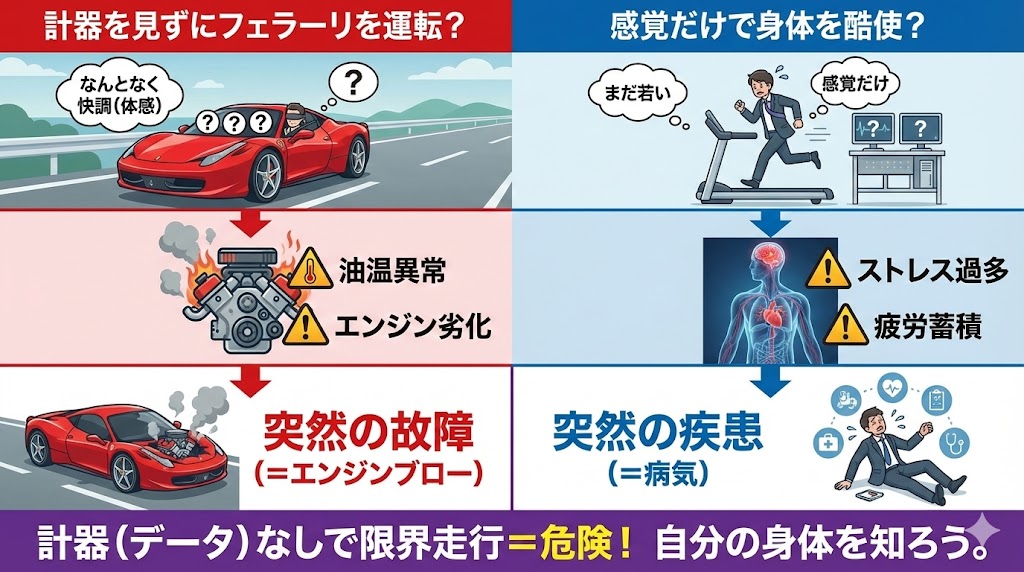
Bridging the gap from “Feeling” to “Fact”
True biohakkinngu is nothing other than the task of reclaiming the “dashboard (gauges)” of the machine called the body.
- How is the current energy efficiency?
- Is the intracellular repair system functioning?
- Is the balance between accelerator (activation) and brake (sedation) maintained?
We “quantify” these using blood tests, genetic tests, and the latest analysis technologies.
If values are visible, it is considered easier to judge more clearly whether what you need now is “rest (pit stop),” “nutritional supply (refueling),” or “engine tuning (treatment).”
Drinking supplements blindly or trying trendy health methods is like turning the steering wheel without looking at the gauges.
First, knowing the “current location” of your own body.
That “Visualization” is indeed the most certain investment for surviving in uncertain times.
What was organized in this article
- Biohakkinngu is not an eccentric body modification but logically managing and optimizing biological functions based on data.
- Modern preventive medicine aims not for a state of “not being sick (not minus)” but for a state where “performance is maximized (positive).”
- It is essential not to rely on the subjective view (feeling) of “feeling somewhat good” but to have objective indicators (data) called test values.
Recap
This time, we explained the concept of biohakkinngu from the perspective of “body piloting.”
Just as higher-performance cars require more precise gauges (dashboards), humans who wish to demonstrate high performance need to grasp their own body data accurately.
However, one question arises here.
“If the body mechanisms are the same, shouldn’t practicing textbook health methods be enough?”
Actually, it is not that simple. Just as there are individual differences even in the same car model, our bodies each have completely different “blueprints” and “metabolic systems.”
Next time, we will explain the medical reasons why textbook health methods may not work for you: “Individual differences in genes and metabolism.”
This article is intended to introduce research background and perspectives only and does not indicate any specific effects or efficacy.
Please consult a physician before considering any treatment or use.