2026.04.06
Is there no benefit to adding NMN infusions?

What the Director’s NAD Measurement Data Reveals About “Subtractive” Aging Care
In our previous discussion, we explored why measuring return on investment (ROI) based on data—rather than intuition—is essential when considering costly health investments such as NMN supplements and infusions.
So what “facts” become visible when we actually measure data? In this issue, we would like to revisit the “NAD measurement data from our clinic’s director”—which generated considerable response when previously featured—from the perspective of health investment “optimization.”
Within this data lie lessons that may prove highly valuable to those engaged in cutting-edge preventive medicine and aging care.
Two “Medical Interpretations” Revealed by the Director’s Data
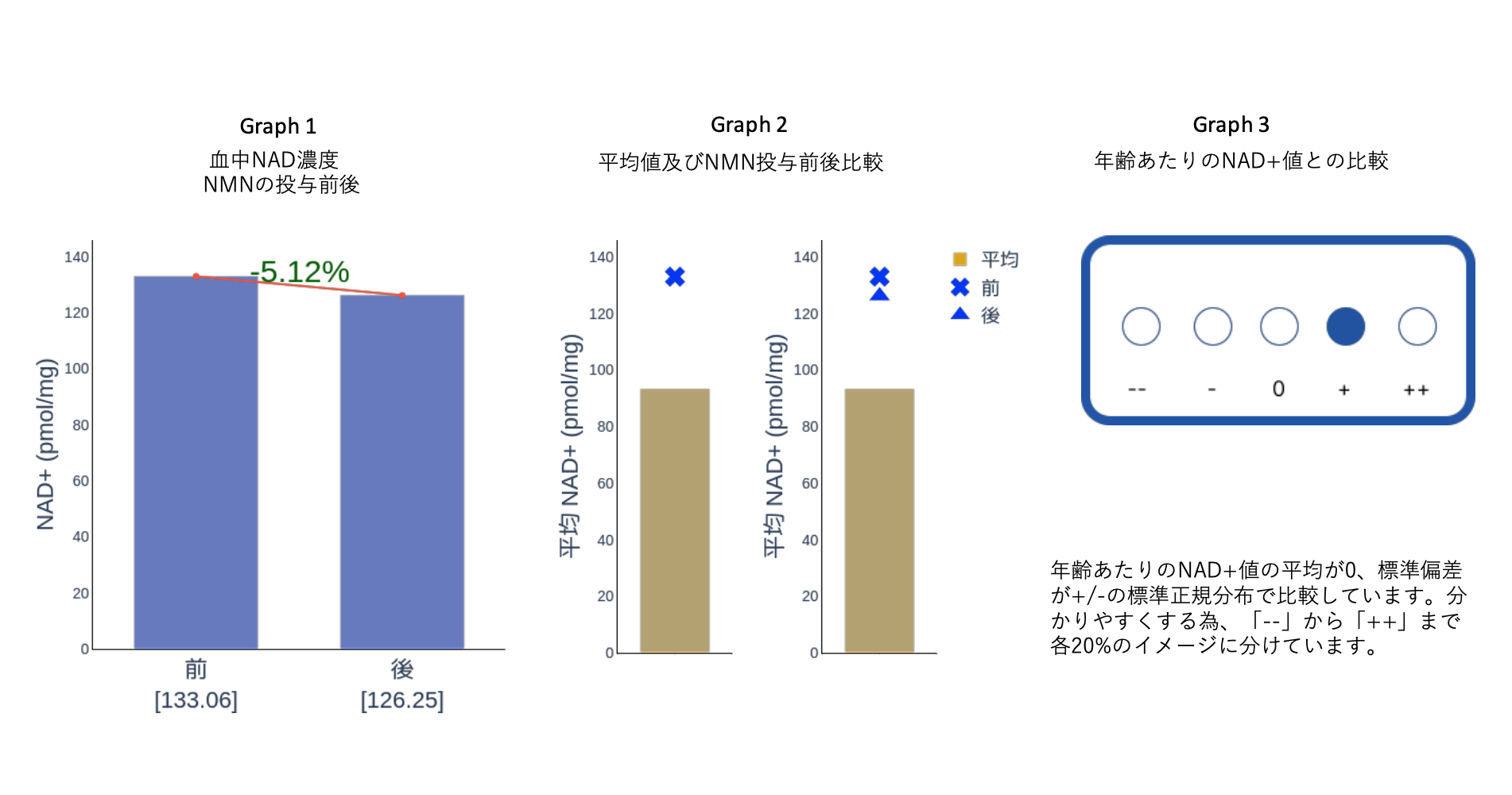
Our clinic’s director takes 1,000 mg of NMN supplements daily as part of a consistent anti-aging practice. Blood was drawn in this baseline state to measure NAD+ concentration—an indicator of cellular energy levels—after which an additional NMN infusion was administered.
Intuitively, one might expect that this dual approach—daily supplements combined with a high-concentration infusion—would produce a substantial increase in post-administration levels.
However, the results were unexpected. The NAD+ level following the infusion showed a change of “-5.12%” compared to the pre-infusion value—a slight decrease, or essentially no change.
Upon hearing this, one might wonder whether the costly NMN infusion was simply ineffective. However, from a medical biohacking perspective, this finding—that levels did not rise—allows us to derive two important interpretations (analogous to management challenges).
Interpretation 1: The “Glass Is Already Full” (No Additional Investment Needed)
In fact, the director’s pre-infusion NAD+ level had already reached its highest level (a state of saturation), well above the average for the same age group, owing to the effects of daily supplementation. Just as investing in advertising within an already saturated market—where 100% market share has been captured—yields no benefit, adding NMN to a glass that is already full simply causes it to overflow.
This is evidence of great success: the current supplementation routine is correct, and the additional infusion is not necessary.
Interpretation 2: The “Bucket Has a Hole” (Resource Leakage and Depletion)
There is another equally important medical interpretation. This involves cases where an underlying issue such as “chronic inflammation” is present in the body. When inflammation exists, enzymes that break down NAD begin to function abnormally. In other words, even as NMN is invested to produce NAD (energy), the NAD being generated is immediately consumed and broken down to address the inflammation.
In business terms, this is analogous to a situation where “funds are invested, yet they disappear through a leak somewhere within the organization.” In this case, a clear strategy emerges: before increasing the amount of NMN, the priority should be to “treat the inflammation (seal the hole).”
The Ability to “Subtract” Is the True Mark of Luxury
What might have happened without this NAD measurement? One might have continued believing that “more infusions would raise the levels,” pouring into a glass already full or a bucket with a hole—wasting valuable money and time.
However, by reviewing the data, it becomes possible to accurately understand one’s current condition and eliminate unnecessary treatments. Continuing only “what is truly necessary for oneself” in a targeted manner—this refined optimization represents the true value of personalized medicine.
What is the current state of your cells—your most fundamental asset? Is the investment of supplements and infusions properly filling the glass, or leaking through a hole?
We encourage you to use “NAD measurement” as a KPI dashboard to assess your current state with clarity and precision.

Key Takeaways from This Article
- When NAD+ levels do not rise following an infusion, two interpretations are possible: “the cells are already at saturation,” or “the NAD+ being produced is immediately broken down due to inflammation or similar factors (the leaking bucket).”
- The director’s data is not evidence that “the infusion was ineffective,” but rather proof of success: “the glass was already full from daily supplementation.”
- By utilizing NAD measurement, it becomes possible to determine whether current treatment is “appropriate,” “excessive,” or “insufficient (leaking)”—enabling “subtractive optimization” that eliminates unnecessary investment.
Review and Preview of the Next Issue
In this issue, we explored the importance of “subtractive aging care”—eliminating waste and identifying underlying issues—through the director’s own data. We hope it has become clear how cost-effective NAD measurement can be as a means of accurately understanding one’s own condition.
In the next issue, we will examine what effects excess NMN may have within the body—what could be described in business terms as “waste of internal resources”—and explore the hidden costs (physical burden) of excessive intake.
We will delve into the metabolic mechanisms that anyone making truly informed health investments should understand.
This article is intended to introduce research background and perspectives only and does not indicate any specific effects or efficacy.
Please consult a physician before considering any treatment or use.