2026.01.26
A Perspective on Insufficient Brain Energy —Can Reduced Concentration and Thinking Ability Be Explained as an “Energy Shortage”?—
In this second installment, we explore declines in concentration and thinking ability not solely as issues of “ability” or mindset, but from a physiological perspective—namely, insufficient brain energy.

Review: Why delivery methods matter
In Part 1, we discussed the idea that NMN is not only about what is taken, but also about how it is delivered.
The brain is protected by the
- substances taken as supplements
- or substances introduced into the bloodstream via IV infusion
do not necessarily reach the brain to the same extent.
From this premise emerged the concept of delivering substances from a location closer to the brain, leading to research interest in intranasal administration—this was the key takeaway from Part 1.
This naturally raises the next question: why is it necessary to focus so much on the brain in the first place?
Is difficulty concentrating really an issue of ability?
- Inability to sustain focus
- Slower decision-making
- Thought processes that stall midway
When faced with such states, many people interpret them as “reduced concentration” or “the effects of aging.”
Those in positions of greater responsibility often try to reassure themselves by thinking, “I’m still fine,” or “I can push through with effort.”
However, recent research has drawn attention to the idea that brain function is influenced not only by willpower and effort, but also by the
One such condition being studied is energy status.

The brain is the most energy-demanding organ in the body
Although the brain accounts for only a few percent of total body weight,
it is estimated to consume around 20% of the body’s total energy expenditure even at rest.
In other words, the brain:
- consumes a particularly large amount of energy compared with other organs
- requires a stable supply of energy
to function properly.
This helps explain why some people feel that “the body still has stamina, but the mind becomes fatigued first.”
Where is the brain’s energy produced?
Within brain cells are small structures called mitochondria.
These act as sites of energy production necessary for cellular activity—essentially, power plants within the cell.
When these power plants function steadily, they support:
- information processing
- organization of memory
- judgment and decision-making
which are core brain functions.
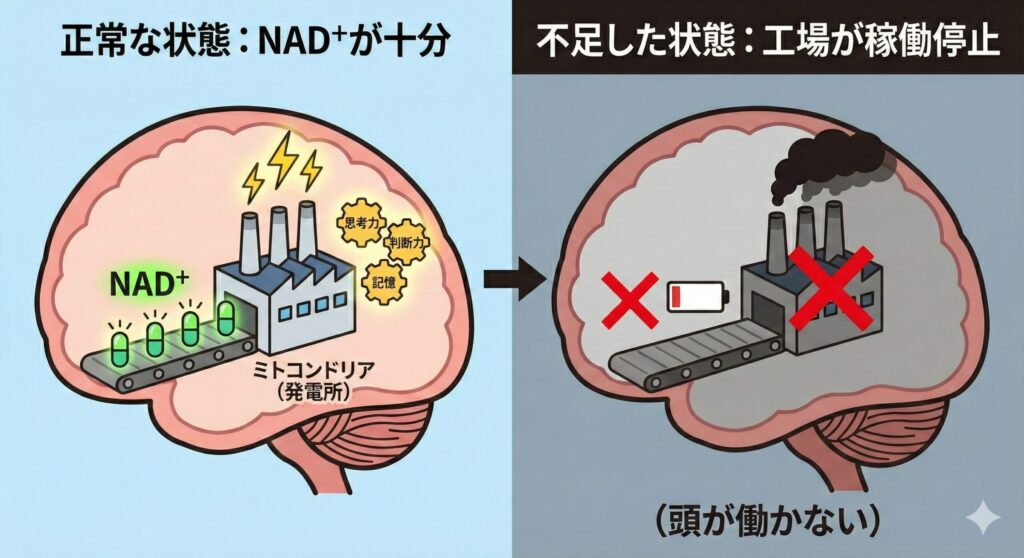
The role of NAD+ in energy production
During mitochondrial energy production, a coenzyme known as
NAD+ is known to:
- play a role in metabolic pathways related to energy production
- contribute to the maintenance of cellular function
and changes in its levels with aging have been reported in animal studies and other research.
From this perspective, studies are examining how such changes in NAD+ may influence brain energy metabolism.
Reframing “lack of motivation” from another angle
When difficulty concentrating persists, it is often interpreted as a drop in motivation or a mental issue.
However, it can also be reconsidered from the standpoint of the physiological conditions affecting the brain.
One way to approach this is through energy status.
If the conditions required for the brain to function optimally are not met, willpower and effort alone may have limitations.
This perspective is also important in that it discourages excessive self-blame.
Why NMN is discussed in relation to brain energy
NMN is a compound that serves as a precursor for the production of NAD+ in the body.
NAD+ is:
- a coenzyme involved in cellular energy production
- reported to change in abundance with aging
Accordingly, because the brain is an organ with particularly high energy demands,
That said, the effects of NMN supplementation on brain function are still under investigation.
Once again, the issue of delivery comes into focus
However, not just any form of supplementation is sufficient simply because it relates to energy.
As discussed in Part 1, the brain is protected by the blood–brain barrier (BBB), making delivery to the brain a complex matter.
This is why the questions of “what to supplement” and “how to deliver it” once again become important.
Key points from this article
- Declines in concentration and clarity are sometimes discussed in relation to brain energy status, not only ability
- The brain consumes large amounts of energy and is sensitive to aging and lifestyle conditions
- Intranasal NMN is introduced as one approach discussed within this brain energy framework
Summary
Reductions in concentration or thinking ability cannot be explained solely by diminished ability or weak will.
The brain is an energy-intensive organ, and its metabolic state is being studied as a factor influencing performance.
Interest in intranasal NMN arises from this perspective on brain energy.
Learn more about our NMN treatments
Coming up next
So far, we have clarified:
- why delivery methods matter
- why brain energy influences performance
as foundational concepts.
The next practical question is: “Which method is right for me?”
In the next article, we will compare the three NMN intake methods—oral, IV infusion, and intranasal—and explain the purposes each may be suited for.
Daily maintenance, whole-body approaches, and brain-focused approaches—
rather than asking “which is correct,” we will explore how to choose based on one’s condition and goals.
This article is intended to introduce research background and perspectives only and does not indicate any specific effects or efficacy.
Please consult a physician before considering any treatment or use.